Guide
Panel fronts: the damage a bad service call leaves behind
The expensive damage on a service call to a paneled refrigerator is almost never done to the refrigerator. It is done to the floor the unit was dragged across, to the panel that came off and went face-down on a stone counter, and to the reveal line along the cabinet run that no longer matches once everything goes back. None of it appears on an invoice, most of it is permanent, and nearly all of it happens in the first ten minutes of a visit where the unit did not need to move at all. A custom panel is a piece of your kitchen, made once, from a run of material that no longer exists and finished in a room it has been aging in ever since.
What a panel front actually is
There are two arrangements and they behave differently. On an overlay installation the appliance door is a normal appliance door and a finished panel is fixed to the face of it, usually into a channel or onto a set of studs, with the handle passing through into the door underneath. On a flush-inset integrated installation the panel sits within the door's own frame and the whole assembly is set level with the cabinet fronts either side, so the tolerances belong to the cabinetmaker rather than the appliance. In both cases the panel came out of the same material as the rest of the kitchen, was finished at the same time, and has aged in that room ever since. That is why a replacement panel rarely matches. It is not the profile that gives it away, it is the color of a finish that has had fifteen years of daylight, and matching it usually means refinishing the doors either side as well.
- Overlay: panel on the face of the appliance door, appliance tolerances
- Flush inset: panel inside the door frame, cabinetry tolerances, no margin anywhere
- Either way: one panel, no spare, and a finish that has aged in place
The ways it goes wrong
Every item below has happened in somebody's kitchen, and none of it is exotic. What they share is haste. A technician who decides the unit has to come out before the grille has even been off is working from a guess, and the damage gets done during the guess rather than during the repair. It is entirely reasonable to ask what reading led to that decision before anything moves.
- The unit walked out over a finished floor with nothing under it: engineered plank scored along a leg track, or a tile lifted at a grout line
- Flooring laid after the appliance was set, leaving a lip the unit gets dragged over instead of lifted
- A panel taken off and laid face-down on stone or grout, or leaned where a door swings
- Handles and screws mixed up, or a screw driven back into a stripped hole in soft panel material
- Hinge cams cranked by eye to correct a door, leaving the panel proud of the run and the gasket half compressed
- A stone overhang used as leverage while the unit is walked forward
- Toe kick or lower trim pried off rather than released, splitting the return
- The door swung past its designed opening once the unit is forward, into an adjacent wall or a return cabinet
Why the unit usually does not need to come out
This equipment was engineered to be serviced in place, which is most of the point of a built-in. The machine compartment and the condenser are reached from the front through the grille. Evaporator fans, defrost heaters, thermistors and drain lines are reached from inside the cabinet once the interior covers are off. The ice maker comes out from inside. Controls generally live behind the grille or an upper panel. The list of jobs that truly require the unit to move is short: a water line or shutoff sitting behind the cabinet, sealed-system work needing rear access, or taking the unit out altogether. If a visit opens with the unit coming forward and no measurement has been taken yet, the sequence is wrong. A diagnosis that has not started at the grille has not started.
- Reached from the front, in place: condenser, condenser fan, machine compartment, most controls
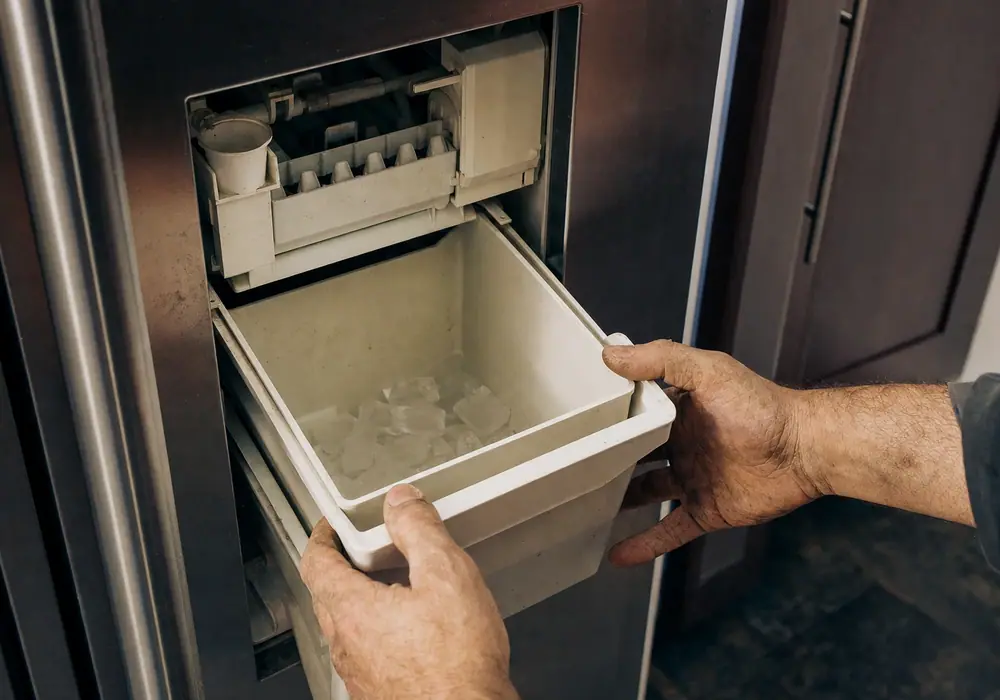
- Reached from inside the cabinet: evaporator fan, defrost heater, thermistor, drain, ice maker
- Needs the unit forward: a rear water fitting, sealed-system access, or removal
What a careful pull-out looks like when one is needed
Sometimes the unit does have to come forward, and there is a version of that which leaves no trace. Panels and handles come off first and go somewhere flat and face-up, out of the traffic. Doors come off if the weight or the width calls for it, which also spares the hinges a maneuver they were not designed for. Protection goes down over the entire travel distance rather than the first few feet, and over the lip if the flooring was laid around the appliance. Leg positions get marked before anything moves, so the unit can be leveled back exactly where it stood instead of approximately. Water is shut off and the line drained before a fitting is touched. The unit comes straight forward on rollers or a strapped dolly, with two people on it, and nothing is levered against the counter or the surround. Then it all goes back in reverse order, and the door alignment is measured against the cabinets rather than glanced at.
- Panels and handles off first, stored flat and face-up
- Protection down for the whole travel, not the first stretch of it
- Leg positions marked before the unit moves
- Two people, straps, and nothing levered against stone
- Alignment and seal rechecked after it goes back, never assumed
Putting the door back so the kitchen still lines up
This is the step that gets skipped, because everything looks fine while the door is shut and the cabinet is cold. Alignment on a paneled unit is a measurement, not an impression. The reveal gap at the top of the panel and at the bottom should match each other and match the cabinets either side; use one object as a gauge at each point, because a two-millimeter difference is invisible standing in front of it and obvious from across the room. Then test the seal. Close a strip of paper in the door at the top corner, at the middle of the latch side and at the bottom, and pull each one out. All three should drag. A door that passes the eye test and fails the paper test at the top corner is precisely the fault that reappears six weeks later as frost near that corner and frost-covered cubes coming out of the ice maker.
- Same gauge at top and bottom of the panel, and against the neighboring cabinet fronts
- Paper test at three points, minimum, with the top corner first
- The door should pull itself the last inch closed under its own weight
- Frost near one corner weeks later is an alignment problem, not a new fault
Before anyone arrives
A few minutes of preparation removes most of the risk. Clear the counter run in front of the appliance and the path back from it, including anything a person carrying a door would have to step around. Say on the phone that the unit wears a cabinetry panel, because that changes what comes on the truck and how long the visit takes. If you know whether the floor was laid before or after the appliance was set, say that too — it is the single most useful sentence an owner can offer about a paneled built-in. And if the panel has already dropped out of line with the run, mention it rather than waiting to see whether anyone notices, because it is usually a symptom of the fault you are calling about.
- Clear the travel path, not just the front of the appliance
- Say that the unit is paneled, and whether it is overlay or flush inset if you know
- Say whether the flooring predates the appliance
- Mention any reveal gap that has already opened up
Questions
Answers before you call
Can a damaged panel be repaired rather than replaced?
Often. Ask a finish carpenter or the original cabinet shop before ordering anything. Edge chips, dents in a soft wood and shallow scratches through a finish are routine cabinet-shop work. The case that goes badly is a whole new panel, because it has to match a finish that has aged in that room for years, which usually means refinishing the neighboring doors too.
The panel and the cabinets no longer line up. Is that damage, or normal settling?
Damage, in the sense that the hinge has been carrying the panel's weight for years. Kitchen cabinetry moves a little, but the fixed boxes either side move together; an appliance door drops on its own, at the outer top corner. Check it with one object as a gauge against the neighboring fronts, top and bottom. The seal along that edge will have gone with it.
Do the doors have to come off for a panel to be removed?
No. The panel is attached to the door and comes off it, so the door stays where it is. Doors come off to cut the weight and width when the unit genuinely has to travel, and to spare the hinges a maneuver they were never designed for. If the unit is not moving, neither the door nor usually the panel needs to come off.
Appliance down in Carmel Valley?
Tell us the brand and what it is doing — we can usually name the likely repair before we arrive.