Guide
How long a Sub-Zero built-in should last, and what shortens it
Twenty years is the honest expectation for the sealed system in a built-in Sub-Zero, and plenty of cabinets well past that are still holding temperature. The trouble starts when that figure gets quoted as though it applied to the whole appliance. The compressor, the condenser and the copper are built to run for decades. Everything arranged around them — fans, defrost heaters, thermistors, gaskets, ice maker parts, the occasional control board — is ordinary hardware with an ordinary working life, and it is meant to be replaced two or three times across that span. Two identical units bought the same year can end up a decade apart in condition, and the reasons come down to four things. Three of them cost nothing.
What is genuinely built to last twenty years
The sealed system is the part that earns the reputation. A hermetically sealed compressor running in clean, cool conditions has no exposure to the outside world: the refrigerant, the oil and the moving parts share a closed circuit that stays uncontaminated for as long as nobody opens it. The cabinet around it has no real wear mechanism either — the steel shell, the foamed insulation and the liner are the same at year twenty as at year one, give or take a shelf. That combination is why a well-kept built-in from the 1990s can still hold within a degree of what it did when it was new, and why the arithmetic on repairing one usually works out. You are keeping the expensive, long-lived half of the machine and replacing the cheap, short-lived parts bolted around it. That is the reverse of most appliances sold today.
- Compressor and sealed circuit: decades, provided it is never opened and never cooked
- Cabinet, liner and insulation: effectively the life of the kitchen
- Condenser coil: indefinite, as long as it is kept clean enough to breathe
What is supposed to wear out, and roughly when
None of the following is a defect. It is the maintenance schedule of a machine that runs continuously for twenty years. Door gaskets take a set and stop pulling themselves shut somewhere in the second decade, sooner on a door opened dozens of times a day or one carrying a heavy panel. Evaporator and condenser fan motors are the most replaced parts in this equipment by a distance, and they give warning first: a whine that grows over weeks, or a tick that comes and goes as the fan cycles. Defrost heaters fail open. Thermistors drift, which is worse than failing outright, because a sensor reading three degrees off is obeyed rather than ignored. Ice maker modules, inlet valves and fill tubes wear on the water side, faster on hard water. Control boards mostly die from power events rather than from age. Hinges, lighting and drawer runners are cosmetic right up until they are not.
- Gaskets: second decade, earlier under heavy use or a heavy cabinetry panel
- Fan motors: the single most replaced part, and the one that warns you longest
- Defrost heaters and thermistors: the reason frost comes back days after you clear it
- Ice maker water-side parts: where hard water shows up first
- Control boards: usually a power event rather than an age
The four things that decide whether yours makes twenty
First, the condenser. A coil packed with dust makes the compressor work against a higher head pressure for longer every day, and heat is what shortens a compressor's life; no other item an owner controls matters as much. Second, ambient temperature. The same model in a cool kitchen and in a hot garage are not the same machine, and a unit boxed in so that it cannot shed its heat is in a hot garage no matter where it stands. Third, the doors. A gasket that no longer seals, or a door hanging a few millimeters low, feeds warm humid air into the cabinet all day and pushes run time up permanently. Fourth, and this is the one that actually kills units, deferred small faults. A condenser fan left to seize does not stay a fan problem: the compressor keeps running with nowhere to send its heat, and a cheap part turns into a sealed-system job. Most prematurely dead built-ins got there through the fourth.
- Free: keep the coil clean, keep the airflow path open, keep the doors sealing
- Cheap: fix a noisy fan while it is still only noisy
- Expensive: everything that follows from doing neither
How to work out where yours sits on that curve
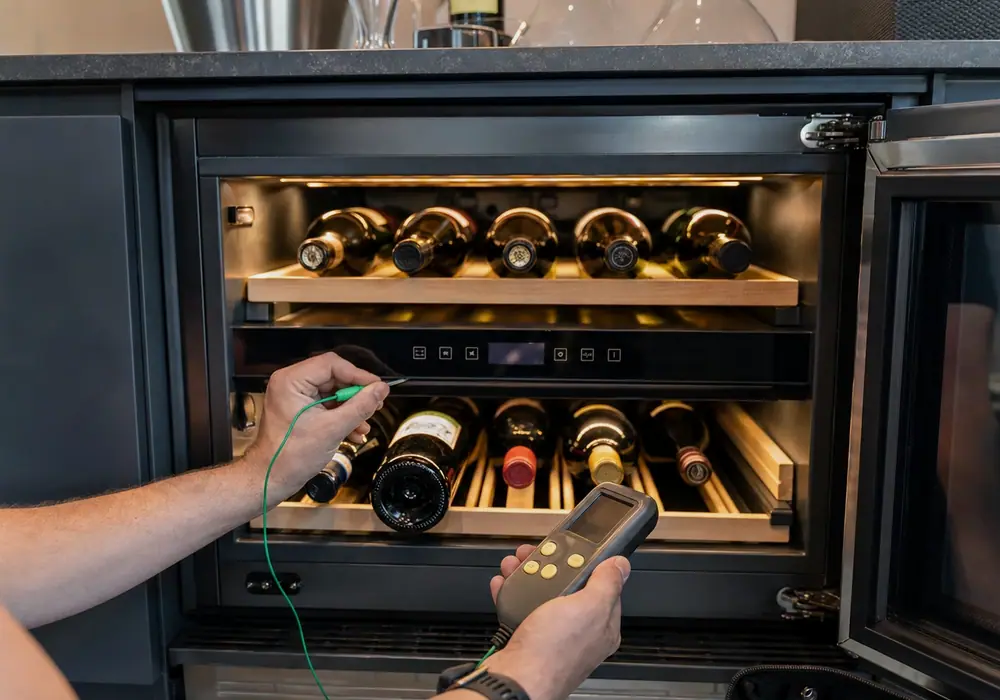
Most of this you can do yourself in ten minutes with a thermometer and a glass of water. Stand the glass in the middle of the fresh-food compartment overnight with the thermometer in it, rather than trusting the door display, which reports the number the unit was asked for and not the one it is delivering. Read it in the morning and again at five on a warm afternoon. Steady at both is healthy. Fine overnight and warm by late afternoon means the unit is short of margin, which is nearly always the condenser or a blocked airflow path rather than a failed part. Then look at the back wall of the freezer: light, even frost is humidity, a heavy pad in one place is defrost. Listen with the kitchen quiet, because a whine that has grown over a month is a bearing. And take the grille off and look at the coil. If you cannot see light through it, it is not cooling anything.
- Steady morning and afternoon: healthy
- Fine overnight, warm by late afternoon: airflow or condenser, not usually a broken component
- Frost returning within a week of being cleared: the defrost circuit
- Ice production falling away over months: the water side, not the refrigeration
- A hum you feel through the floor more than you hear: compressor mounts, and not urgent
When an old one is worth keeping, and the case where it is not
The arithmetic on a built-in is unlike a freestanding refrigerator's for two reasons. The cabinet is fitted to the kitchen, so replacing it can mean cabinetry, panel and sometimes counter work on top of an appliance. And the expensive component is the one most likely to still be good. If the sealed system is sound and the fault sits outside it — a fan, a heater, a thermistor, a gasket, an ice maker, a board — repair is almost always the cheaper answer by a wide margin, whatever the unit's age. The case that goes the other way is narrower than people expect: a sealed-system failure or a leak in a cabinet old enough that its refrigerant is no longer produced, or one where the evaporator has corroded, or where several systems are tired at once. That is a real conversation about replacement rather than an automatic one. What should never decide it on its own is age. A twenty-two-year-old cabinet with a dead evaporator fan is a small repair, not an old refrigerator.
- Fault outside the sealed system on a sound cabinet: repair, nearly every time
- Sealed-system failure on a very old cabinet with other systems already tired: a genuine replacement conversation
- Age by itself: not a reason for anything
Questions
Answers before you call
Is twenty years an average or a best case?
It is a reasonable expectation for the sealed system rather than an average for the whole appliance, and it assumes the coil has been kept clean and the unit has not spent its life in an enclosure that traps heat. Cabinets well past twenty are common; so are units that failed at twelve, and the difference is maintenance and installation, not luck.
Does running it colder wear it out faster?
Setting a compartment colder than it needs to be adds run time. The bigger mistake is turning the setting down in response to a compartment already failing to hold the temperature it was given: that achieves nothing except continuous running, because the fault was never the number it was asked for. Find out why it cannot hold the first one.
How often does the condenser really need cleaning?
Twice a year suits most kitchens, and the honest test is visual rather than a date: with the grille off, if you cannot see light through the coil it is overdue. Shedding pets, a dusty or newly finished house, and a unit standing in a warm space all shorten the interval. It costs nothing but the time.
Appliance down in Carmel Valley?
Tell us the brand and what it is doing — we can usually name the likely repair before we arrive.